Research
Our research into our documentary on squatting only began when we returned after Christmas. We spent a great deal of time looking on the internet and in articles for any groups or contacts that we could find.
We spent a great number of hours scrawling through page after page of information. We visited many different that gave advice on squatting, offered help to squatters looking for a place to sleep, newspaper articles about squatters and sites that had general information on squatting.
One of the these sites had a information about a book called 'The Squatters Handbook', which is published by the Advisory Service for Squatters (www.squatters.org.uk). It gives advice on how to survive as a squatter, how to get into houses, how to avoid being thrown out and much more. Here's an example:
The Squatter's Handbook advises:
- Force entry in through either the front or back entrances open windows. Carry a crowbar and say you are "cleaning drains" if you are stopped.
- Break in during the day, and "wear council-style overalls" to avoid suspicion.
- Deactivate alarm sensors with sellotape, and muffle the sound of alarm bells with a few coats.
- Put up a legal warning on the door - warning it is a criminal offence tot try to remove the squatters by force. Local residents and home owners are intimdated with "you may receive a sentence of up to six months' imprisonment and/or a fine of up to £5000".
- Apply for council tax benefit as soon as you move in. Don't let TV Licensing inspectors in, they can only come in if invited.
- Cite the Human Rights Act 1998 if the gas and electricity firm won't reconnect you. Cite the Water Industry Act 1999 if the water firm tries to disconnect you.
- Only a small minority of squatters ever get nicked... squatting is not a crime.
- Private houses may provide years of housing to lucky squatters.
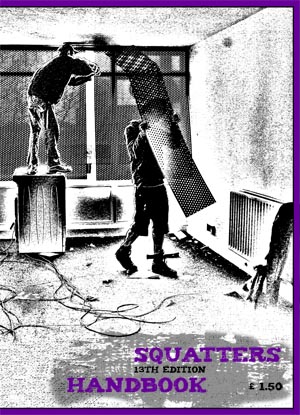
That is just a small example of what can be found in the book. It is very interesting to read and opened our eyes to the things that a person can do to avoid paying for rent and bills. This helped us to begin to see what it takes to live as a squatter and how much effort truly goes into maintaining the lifestyle.
The handbook was useful but it was the publishers we were most interested in. We emailed the Advisory Service for Squatters and received a very quick response. They wanted to know what our intentions for the documentary were, the experience we had had in documentary and what we wanted from them. After a while we stopped receiving emails and decided to call them directly, we did not get through to the person who we had originally been talking to, but the person we did speak to was very pleasant and willing to help us as much as he could. They could not put us into direct contact with any squatters as it would be immoral to break the privacy of their contact details, but instead they agreed to post our aims and contact details onto the board that is used to show the available housing to squatters. This meant that anyone who wanted to get into contact with us could do so of their own choice. This admittedly did not yield success but did encourage us to continue trying.
We emailed several groups during the week and were now starting to get responses from some of them. We decided though that as we need to progress with our documentary quicker it would be best if we called these people directly so that we could get a quicker response. The first group we contacted is called 'The Oubliette'. They are a group of people that have taken over large, very expensive houses and apartment blocks and have transformed them from unused buildings and into, what they call, Arthouses. We originally heard of the group due to a Guardian article from the 21st of December 2009 (www.guardian.co.uk/society/2009/dec/21/oubliette-art-group-not-squatters). We talked with a member of the group and after explaining who we were and what our documentary was about he and their PR company agreed to meet with Wednesday 3rd March at 5pm in The White Horse pub in Soho. The group does not refer to themselves as squatters, but we feel that meeting with them can only be beneficial and hopefully we will be able to set another time with them when we can spend sometime with them filming.
After the success with 'The Oubliette' we then contacted a man who we had heard of from an article in the Guardian (INPUT LINK TO GUARDIAN ARTICLE) his name won't be disclosed until he agrees to us using it. He works with a group called 'Circle Community' (www.circlecommunity.org), in the past he has run workshops for squatters and the homeless that have included such things as skateboarding, musical and art. When we called the first time we disturbed him whilst he was in the bank and so called back 10 minutes later with more success this time around. He was incredibly nice and very helpful he told us what he did and we told him what we would hope to get from meeting with him. After a short talk he invited us to a film night he has set up for the homeless and for squatters. We will be meeting him at 5-6pm on Tuesday evening to join him at the film night where he will also be introducing us to some of the squatters he knows and to some international squatters who have been all over the world squatting. We're hoping that this meeting will firstly help us to make more contacts in the squatting world and build up more dates for interviews with people. But secondly to understand what it is that he does and why he does it.
We found through the course of our research that newspaper companies are great sources of information (in particular The Guardian). The next person that we contacted was a young woman who had commented on a guardian article, about squatters being moved out of Mayfair in London, she was incredibly passionate about how the squatters had been treated and talked about how she had helped move them from Mayfair to Peckham (GUARDIAN ARTICLE LINK). This passion is what drew us to her and we began trying to find out how to reach this woman. We discovered that she worked for a costuming company named Prangsta (www.prangsta.co.uk). We contacted the company and they provided us with a direct line to the person we thought we were looking for... this didn't turn out to be correct as the man had heard the name wrong. Luckily the woman I spoke to was happy to give us the right number, as the woman had spoken about the emails she had received from us. With the right number we rang again but had no answer, so instead sent a very long text message explaining the documentary and who we were. Later that evening we received a text message from the woman inviting us to ring her again. The conversation was only short, but she told us that not only had she helped move the people from Mayfair to Peckham, but that she was living in a squat in South East London. We have been invited to join her for dinner on Wednesday 3rd March at 8:30pm.
A member of our group (Georgia) has an aunt who lives in Brighton. After she spoke to her it was revealed that her aunty knew people who work in a shelter and people who have lived in squats. We have not yet set a date for travelling to Brighton but we definitely intend and hope to meet some squatters from a different area of the country. With this being family orientated travel will be a great deal simpler and the likely hood of results is also higher.
We have been very happy with what our research has so far got us and we will continue to try and find more groups and people to meet with.
